Zone of Interest
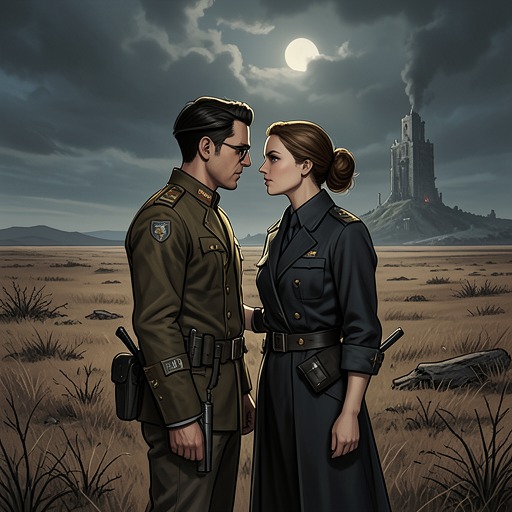
The Zone of InterestThe Zone of Interest is at once a place entered by way of Kat Zet I and a moral space in which people are exposed by the choices they make under National Socialism. The narrative sets its boundary beside ordinary paths, buildings, and routines, then returns to the zone after the war as a way of thinking about what people discovered—or disclosed—about themselves. Its geography is therefore inseparable from its argument: to enter the zone is to come within reach of the camp, but also of truths that ordinary life cannot keep outside.
Setting and Threshold
One approach to Kat Zet I begins with an image of cultivated normality. A woman in a white ankle-length dress and straw hat, carrying a straw bag, walks with two girls dressed similarly. They cross the drive of the Equestrian Academy, passing an ornamental windmill, a maypole, a three-wheeled gallows, and a carthorse tethered to an iron water pump. The scene’s composed, almost ceremonial detail makes the next movement stark: the three continue beyond these familiar-looking features and into Kat Zet I. The narrative then marks a sudden disturbance, describing the experience of first sight through a sequence of weather—lightning, thunder, cloudburst, sunshine, rainbow.
The passage does not explain the whole geography of the zone, but its abrupt transition establishes a consequential border. The drive and its ornamental objects belong to an ordered landscape; Kat Zet I is the destination into which that order opens. The zone is not introduced as an abstract historical label. It is approached on foot, across a drive, and entered from a place where children play and a horse is tethered. That juxtaposition makes proximity itself part of the setting’s meaning.
Routes, Weather, and Surveillance
The Zone of Interest also takes shape through movement between places. On a Friday, Angelus Thomsen walks from the Old Town toward Kat Zet I. Realizing that he is no longer being followed, he turns east and continues to the Summer Huts, where he does not expect company. The route passes through a landscape of thin, cold rain, smoke-soiled clouds, deserted playground, and shuttered, sodden chalets. The weather and abandoned recreation grounds answer to his mood and his hopes of seeing Hannah; the search proceeds through sand and scrub rather than along a reassuringly open path.
Elsewhere, the sense of movement through the camp’s world becomes inseparable from the fear of being watched. Thomsen recognizes the sensation from his former work in Military Intelligence: an invisible connection to a follower seems to tighten or slacken with distance, until a turn of the head catches the person behind him. The figure is a prisoner in stripes, a Kapo whose green and red triangles identify him as both criminal and political. Thomsen considers whether the man might simply be a persistent passerby, but reads his dour expression as threatening. He wonders who has set the surveillance in motion. The detail makes the zone more than a destination on a map: it is an environment where the routes people take and the people who follow them are charged with uncertainty.
Hannah and the Zone Remembered
The connection between the zone and Hannah becomes explicit in the later section titled “Hannah: The Zone of Interest.” In September 1948, Thomsen drives south-east on what he calls a fool’s errand, hoping to get closer to the end of his hope and exhaust it. Postwar life has supplied visible signs of recovery: currency reform has replaced the cigarette economy, and he has work, friends, and familiar public routines. Yet these external changes have not given him a self-sufficient inner life. His memories of Hannah recur, but he feels that the story between them was almost entirely unbegun.
Those memories are inseparable from the conditions in which he knew her. He recalls the pleasure of her stance, the way she held a glass, talked, and crossed a room; then he asks where those interactions had taken place, what stench the walls and ceilings could not exclude, and whether the man beside her was her husband. The remembered Hannah existed, he recognizes, in misery and in a place its custodians called Anus mundi. The novel makes the tenderness of his recollection collide with the reality surrounding it: the intimate gestures he remembers cannot be detached from the camp’s setting and the suffering that setting contained.
Thomsen’s postwar search for Hannah’s maiden name gives this unresolved memory a concrete direction. He reasons that she met Paul Doll in Rosenheim and may have married him there, so he goes to Rosenheim. The journey does not erase the uncertainties he has already named. Instead, it shows how the zone persists beyond its physical boundaries: after the war, the search for Hannah’s identity still leads back toward the life she had within its shadow.
The Zone as a Moral Mirror
In 1948, Thomsen reflects that under National Socialism a person looked in the mirror and saw a soul revealed. He applies this idea not only to victims, but also to perpetrators, collaborators, witnesses, conspirators, martyrs, and minor obstructors such as himself and Hannah. Their positions and actions are not equivalent, but all are placed within a history that makes character legible through what people do, suffer, witness, or resist. The zone is the point at which that exposure becomes unavoidable.
The distinction matters especially to Thomsen’s account of himself. During the Third Reich, he had felt doubled, as though one self acted while another remained separate; after the war, he feels halved. His account does not turn limited obstruction into innocence, nor does it claim that his knowledge of Hannah amounted to knowing her whole life. On the contrary, he admits that the Hannah he remembers may be only a partial acquaintance. The Zone of Interest names the space where this gap between perception and knowledge becomes ethically charged: it is a setting in which people are revealed, but not necessarily fully understood. Its final significance lies in that tension between what the zone exposes and what a survivor or witness can still fail to know.